
President Donald Trump stated that Tehran is seeking a diplomatic opening with the U.S., even as reports indicate the death toll from the recent domestic crackdown has climbed to at least 646 people.
While Tehran hasn’t officially responded to Trump’s claims, a recent visit by Oman’s foreign minister—a traditional mediator—suggests backchannel movement, though deep divisions over Iran’s nuclear and defense capabilities remain a major hurdle.
Iranian Foreign Minister Abbas Araghchi claimed during a briefing with diplomats that order has been restored, alleging without proof that the unrest was a conspiracy orchestrated by Israel and Washington.
Araghchi argued that the bloodshed was a calculated effort to justify American interference, while Al Jazeera continued live broadcasts from the country despite the state-imposed digital blackout.
Despite the rhetoric, Araghchi expressed a willingness to engage in diplomacy, a sentiment echoed by ministry spokesperson Esmail Baghaei, who insisted that any future dialogue must be a balanced exchange rather than a dictated ultimatum.
On Monday, the regime countered the anti-government sentiment by mobilizing thousands for pro-theocracy rallies, where crowds chanted slogans against the U.S. and Israel in a display of loyalty to the aging Supreme Leader.
Religious and legal authorities have heightened the stakes, with the attorney general characterizing protesters as “enemies of God,” a designation that carries the threat of capital punishment.
White House spokesperson Karoline Leavitt noted a discrepancy between Iran’s aggressive public stance and the more conciliatory private communications currently reaching the administration.
While the president is open to exploring these private overtures, Leavitt emphasized that the U.S. remains prepared to deploy military force if the situation warrants it.
Internal discussions at the White House are reportedly centered on various retaliatory measures, including potential kinetic strikes or cyber warfare, according to sources familiar with the administration’s strategy.
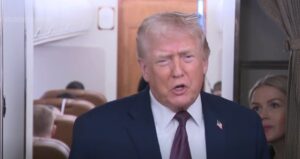
“We are considering some very potent alternatives,” Trump remarked on Air Force One, vowing that any Iranian retaliation would be met with military force on an unprecedented scale.
Adding economic pressure to the mix, Trump utilized social media on Monday to announce an immediate 25% tariff on any nation maintaining trade relations with the Islamic Republic.
This move reflects the president’s preference for using trade barriers as a primary lever to coerce international actors into aligning with his foreign policy goals.
The broad economic impact of these tariffs is expected to hit major global players like China, Russia, Turkey, Brazil, and the UAE.
Further clarification on the specifics of the tariff policy was not provided by the White House following the announcement.
Trump indicated that while talks are being organized, the worsening humanitarian situation and the ongoing wave of arrests might force him to take decisive action before any meeting occurs.
“They want a way out,” the president suggested, claiming the Iranian leadership is looking for a reprieve from sustained U.S. pressure.
Countering this, the speaker of Iran’s parliament warned that any U.S. or Israeli military intervention would turn their forces into “legitimate targets” for retaliation.
According to the Human Rights Activists News Agency, the two-week unrest has resulted in over 10,700 arrests and a death toll including 512 protesters and 134 security personnel.
Verifying these figures remains difficult due to the comprehensive shutdown of internet and communication lines, which has prevented independent observers from confirming casualty totals.
Human rights groups worry that this information vacuum allows security forces to operate with impunity, even as fragmented video evidence suggests that demonstrations have persisted.
State media attempted to project an image of stability on Monday by broadcasting large crowds moving toward Tehran’s Enghelab Square in support of the government.
These broadcasts framed the pro-regime rallies as a stand against foreign-backed “terrorism,” largely ignoring the deep-seated economic grievances fueling the actual unrest.
Local reports from the capital describe an atmosphere of profound dread, with streets becoming completely abandoned as soon as night falls.
This silence is enforced by chilling government warnings sent via text message, advising families to keep children indoors as authorities vow to handle “rioters” with zero tolerance.
Additional warnings from the Revolutionary Guard’s intelligence wing have been sent directly to the public to discourage any participation in the protests.
Sources within the city provided these details under anonymity, citing the severe risk of reprisal from the state security apparatus.
The current wave of instability initially sparked over the collapse of the national currency and general economic malaise, but it has since transformed into a fundamental challenge to the theocratic system itself.