
President Donald Trump announced he has scrapped planned discussions with Iranian representatives due to their violent suppression of protests, assuring the Iranian people that assistance is forthcoming.
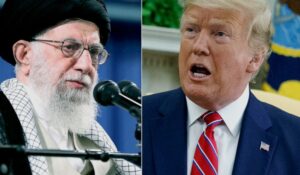
On Tuesday, Trump declared an end to potential diplomatic engagements with Tehran as the regime cracks down on dissent, sending a message to the populace that aid is imminent.
While the President did not specify the nature of this assistance, his announcement follows recent comments suggesting Tehran was eager to negotiate after he threatened military strikes. Meanwhile, rights groups estimate the death toll from the nationwide unrest has exceeded 2,000.
However, Trump’s most recent statement on social media signals a sudden reversal in his openness to diplomatic dialogue with the Islamic Republic.
Writing on Truth Social in the morning, Trump urged Iranian patriots to seize state institutions and document human rights abuses. He warned that perpetrators would face consequences, stating he has suspended all meetings until the violence ends, reaffirming that help is coming.
The President has frequently warned Tehran of military intervention if the government utilized lethal force against demonstrators. On Sunday, he noted that Iran was crossing that red line, prompting his national security team to consider severe responses, even as he acknowledged Iranian diplomatic overtures.
By Monday, however, the administration expressed cautious optimism that a diplomatic path might still exist.
White House Press Secretary Karoline Leavitt noted a discrepancy between the regime’s public rhetoric and private communications, indicating the President’s willingness to investigate those backchannels. She added, however, that Iran is fully aware of Trump’s readiness to deploy military force if required.
That same day, Trump announced immediate 25% tariffs on nations trading with Iran, though the White House has yet to release implementation details. Major economies such as China, Russia, Brazil, Turkey, and the UAE could be affected.
A strategy meeting involving Vice President JD Vance, Secretary of State Marco Rubio, and National Security Council officials commenced on Friday to outline potential courses of action, spanning from diplomacy to kinetic strikes.
In response, Iran’s parliamentary speaker cautioned that American forces and Israel would be considered valid targets should Washington intervene militarily to defend the protesters.
The Human Rights Activists News Agency reported Tuesday that over 600 distinct protests have occurred across all 31 provinces. The group detailed casualties including 1,850 protesters and 135 security personnel, with detention figures surpassing 16,700.
Verifying the true magnitude of the uprising remains challenging due to information restrictions. State media offers minimal coverage, while social media clips provide only fleeting, chaotic glimpses of street violence and gunfire.
This escalation with Iran adds to a crowded docket of international crises currently occupying the President.
It follows closely on the heels of a U.S. military operation that removed Nicolás Maduro from power in Venezuela just over a week ago, with American forces remaining heavily positioned in the Caribbean.
Simultaneously, Trump is attempting to advance the second phase of an Israel-Hamas peace accord and negotiate an end to the protracted war between Russia and Ukraine.
Nevertheless, proponents of a hawkish stance argue that the current unrest presents a unique chance to destabilize the theocratic regime that has governed Iran since 1979.
Triggered by a collapsing currency, these demonstrations represent the most significant challenge to Supreme Leader Ayatollah Ali Khamenei in years, evolving from economic grievances into a direct test of his authority.